Monday, October 09, 2006

Apotik Komik Disbands (?)


Library Room, Jogja Gallery, Saturday, October 7, 2006
By Nunuk Ambarwati

On the Subject of Apotik Komik
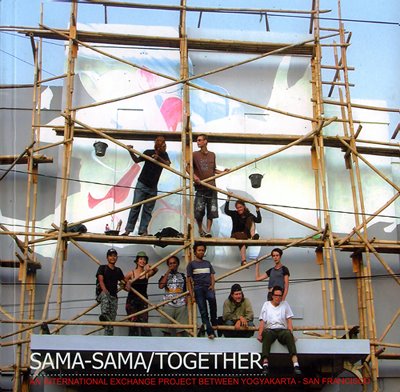
In the series of grand launching Jogja Gallery (JG) and visual arts exhibition “ICON: Retrospective” −curators: Mikke Susanto and M. Dwi Marianto− from September 19 until November 19, 2006, JG launched a book entitled Mural Sama-sama/Together published by Kelompok Apotik Komik and Clarion Alley Mural Project (CAMP), San Fransisco, declaring a public statement on the disbandment of the group. In my opinion, the formation of its membership fluctuates, easy comes easy goes so that it is quite hard to identify who the members are. However, JG managed to present some individuals who used to be the members of ex-Apotik Komik represented by Arie Dyanto, Samuel Indratma, Arya Pandjalu, Nano Warsono but without the presence of Ade Tanesia and Mie Cornedeus as scheduled in the publication previously released. The four people began the program by presenting skillfully their art works and mural activities both in Yogyakarta and San Fransisco. It was significant to present Apotik Komik as one of the icons in visual arts mapping in Yogyakarta particularly and Indonesia generally considering that this group was the pioneer in socializing and re-interpreting broadly on what and how the real public art was. The techniques applied by them were murals, graffiti, stencils, texts, and the sorts. The medium aspects and capacity to penetrate public spaces in Yogyakarta were the key points to count on.


What is next after Disbandment?
The phenomenon of murals in Yogyakarta has been initiated since 2000. The strategic point signaling the mural movement by Apotik Komik was the murals along the fly-over wall in Lempuyangan in 2002. It is interesting to notice that the local government, in this context is the mayor (at that time was H. Herry Zudianto), strongly supported the movement. The direct impact is that it becomes “a snow ball” keeping on rolling and becoming bigger. Numbers of mural movements have been spread in each wall corner in Yogyakarta until today. With a variety of techniques, symbols, and messages, many youth communities turn out to be in existence. Their murals can be found and learned as history records on the development of mural arts in Yogyakarta.

By the time of the rolling “snow ball” in such hot spirit among the bombers −the call refers to the artists of graffiti and murals−, Apotik Komik faced up to a crisis on the complexity of different visions among its members. The group beginning its activities to socialize wide-ranging awareness on the importance of public spaces through visual arts works in 1997 had to declare its disbandment in 2005. According to Arie Dyanto, the friction among them had become complicated in 2004. Yet, as a matter of fact, the disbandment of this group was in the discourse stage of the state in the following year. Many parties were made intricate on this situation. Although on that evening discussion they did not mention the reason of disbandment explicitly, the official statement to public declared on the disbandment was very important as a manifestation of their social responsibility to public as well as their position in Indonesian visual arts mapping relating to many art projects in the future possibly to be taken and developed by them.

The disbandment of Apotik Komik is no longer a mystery especially in the circle of visual arts practitioners. In fact, it is such a common thing to happen on the rise and sink of any group or community. Numbers of communities rise easily even though they consist of former people just like Apotik Komik. For them, each ex-members as Samuel Indratma and Arie Dyanto will continue working on the issues of public spaces and mural arts without Apotik Komik so that the emerging topics of the discussion on that evening was how the mural movements in the coming days in Yogyakarta might be.

Visual Trash versus Regulation
After the disbandment of Apotik Komik, it was evenly discussed the government officials’ shifts (the mayor, for instance) that would bring consequences on the policy changes and support types provided. So, what should the artists or public do toward the existing murals while the images remain identical torturing our visual point of views for years? An input offered on the discussion showed the importance of making a regulation equivalent to Peraturan Daerah (Perda)/Local Offical Rules ruling a number of visual objects in public spaces in Yogyakarta taken as visual trashes. A huge number of graffiti on the walls and huge sponsor messages afflicting the city landscape had made a city as Yogyakarta more and more crowded. It could not be denied that they were one of the tempting income sources to the local government of Yogyakarta but they could be managed in such elegant and contiguous ways indeed. Take an example, there was a negotiation possibility between artists and businessmen to work for their sponsor messages such as billboards, banners, and so on by presenting more artistic shapes and taking the beauty of all city sides entirely. Samuel gave a solution on that problem by renewing visual images of murals with new movements and messages. It was Samuel’s optimism by taking in businessmen who were ready to work in line with these matters. “Just wait for the realization in the coming year”, Samuel promised.

One Book Three Year
Mural Sama-sama/Together is worthy to be collected just as a memoir book, a remembrance on the presence of a group namely Apotik Komik in Yogyakarta. The book was printed for 1000 copies and sold Rp 70,000,00 per copy dedicated to be such pension fund (as they joked) for each ex-member to continue presenting various art projects in public spaces in the future. By buying the book, it means that you have contributed in the efforts of awareness-raising on public spaces through their personal projects in the future. As explained by Arie Dyanto, it took three years to process the book from collecting documentation on writings and photos, designing, and printing. The 158-paged book equipped with full color images on the works and creations achieved by Apotik Komik had been launched on that evening. Some writings on the book are dominated with the topics of collaborative works between Apotik Komik and CAMP as written by Megan Wilson (Curator and Co-director of CAMP) in Two Communities and Beyond which is strengthened by the writing of Ade Tanesia (Manager of Apotik Komik) in The True Cultural Exchange. The book becomes a critical stepping point to portray us that a community may be retired but its mission should be disseminated in different ways though.
A Glance on Jogja Gallery
Jogja Gallery was established in September 19, 2006 and opened officially by Gubernur Daerah Istimewa Yogyakarta (DIY), Sri Sultan Hamengku Buwono X. JG is located in the zero kilometer or Northern Square area as the heritage landmark in the city center of Yogyakarta. It rests in Soboharsono ex-theater building (built in 1929) functioning from the Dutch colonization. JG, a visual arts gallery with international quality and technology was established by PT Jogja Tamtama Budaya in association with Keraton Ngayogyakarta Hadiningrat as the land and building owner. To some extents, it brings a vital role as a meeting point between art workers and large society attempting to facilitate the prospective resources of Yogyakarta as cultural, historical and potential city to develop as well as one of international tourism destinations. The public services designed are periodic exhibitions, non-exhibition programs (education programs for children and adults, public, and students), exhibition and non-exhibition collaborations, friends of Jogja Gallery, library, art award forum, art shops and consignments, and Banaran Café and restaurant as well. Welcome and enjoy the exhibition at Jogja Gallery entitled “YOUNG ARROWS: Indonesia’s 40 Most Outstanding Artists” held from December 2, 2006 until January 2, 2007!
*
Gallery opens on Tuesdays - Sundays from 9 a.m. until 9 p.m.
Administration is on Mondays - Saturdays from 8 a.m. until 4 p.m.
Banaran Café and Restaurant opens daily from 9 a.m. until 12 p.m.
Jogja Gallery [JG]
* Contact person: Nunuk Ambarwati [Manajer Program Jogja Gallery]
Jalan Pekapalan No 7, Alun-alun Utara, Yogyakarta
Telepon +62 274 419999, 274 7161188
Fax +62 274 412023
Email [1] jogjagallery@yahoo.co.id
[2] info@jogja-gallery.com
www.jogja-gallery.com

Tuesday, October 03, 2006

Menimbang Ulang sebuah Program

Program 'Aku Oke!' di dusun Tegal Kebon Agung, Imogiri
Kerjasama YSC & Papermoon

Sebuah Evaluasi untuk Crash Program Bencana Gempa
di Yayasan Seni Cemeti
Oleh Nunuk Ambarwati

Bencana gempa bumi berskala 5,9 skala Richter, 27 Mei 2006 yang lalu memang menjadi milik bersama di wilayah Yogyakarta dan sekitarnya. Melihat dampak yang terjadi yang meluluhlantakkan sebagian besar rumah penduduk, banyaknya korban yang berjatuhan dan sekaligus sebagai individu yang juga mengalaminya saat itu; keinginan untuk berbuat lebih dan membantu para korban menjadi skala prioritas pada masa tiga bulan pertama paska bencana. Status sosial, jabatan, definisi instansi mau pun pengkotakan profesi sepertinya sudah sekian tipis batasnya. Pada fokusnya, semua orang ingin membantu, semua orang melakukan penggalangan dana bahkan hingga menciptakan program-program guna pemulihan secepatnya kondisi sosial, ekonomi, psikologis paska bencana tersebut. Situasi demikian kemudian menjadi sebuah hal yang secara inheren, spontan, simultan dan menjadi tanggung jawab kita bersama untuk dilakukan.


Menanggapi bencana gempa yang dialami Yogyakarta dan sekitarnya tersebut, tak kurang-kurang aliran donor berbentuk nominal uang mau pun logistik terus datang dengan derasnya. Dihadapkan pada hal situasi demikian, berbagai lembaga, baik LSM (Lembaga Swadaya Masyarakat) mau pun non LSM dihadapkan pada sikap tanggap darurat, bagaimana mendistribusikan semua bantuan para donor tersebut hingga ke tangan yang tepat. Bagaimana menyikapi situasi paska bencana, bantuan apa yang cocok bagi para korban hingga masalah laporan pertanggungjawaban kemana saja larinya uang sumbangan tersebut dan untuk apa saja. Bagi lembaga semacam Yayasan Seni Cemeti (YSC) yang telah bergerak di bidang seni visual selama kurang lebih 11 tahun (berdiri tahun 1995), sebuah lembaga dengan reputasi kerja sedemikian solid dan dikenal hingga ke skala internasional, YSC pada akhirnya juga banyak mendapat kepercayaan berbagai kalangan untuk menitipkan donasi mereka guna didistribusikan.

Hal semacam itu, baik terlibat langsung mau pun tidak langsung pada usaha pemulihan paska bencana, merupakan satu pengalaman tersendiri bagi YSC. Dimana selama 11 tahun tersebut, YSC selalu terkondisi dengan adanya funding tetap, dengan besarnya dana dari funding tersebut yang juga teratur, program-program yang telah dirancang matang sesuai misi dan visi YSC sendiri. Sebuah lembaga yang mencoba membawa misinya untuk melakukan pemberdayaan infrastruktur seni visual melalui kegiatan utamanya yakni dokumentasi dan riset, serta kegiatan pendukungnya antara lain penerbitan buku, pameran seni visual, workshop, diskusi dan pendidikan alternatif.

Meskipun batasan pemberdayaan infrastruktur seni visual itu sendiri kemudian bisa dijabarkan sedemikian luas, tetapi jelas di sini bahwa YSC bukanlah lembaga yang memang difokuskan untuk melakukan program menghadapi bencana mau pun pemulihan paska bencana. Toh YSC juga kemudian tetap peduli pada situasi bencana tersebut, dimana YSC, baik lembaga mau pun para staf yang bekerja disana, juga merupakan bagian dari Yogyakarta. Maka selain program penyaluran logistik secara langsung kepada para korban, YSC bekerja sama dengan komunitas Papermoon, mengemas sebuah program bertajuk ‘Aku Oke!’, sebuah program pemulihan paska bencana yang difokuskan untuk anak-anak di dua dusun binaan, yakni di dusun Tegal Kebon Agung, Imogiri dan di dusun Wirokerten, Sampangan, Bantul. Program ini telah berlangsung sejak 2 minggu setelah gempa, sekitar awal Juni dan direncanakan akan berakhir awal November 2006. Tujuan dari program ini mengajak anak-anak korban bencana gempa untuk tidak berlarut-larut dalam kesedihan atas bencana yang telah terjadi dengan mengajak mereka melakukan berbagai aktifitas bermain dan belajar.

Semula ‘Aku Oke!’ dihadirkan, memang direncanakan menjadi program yang ‘ringan’, bukan sebuah program dengan durasi yang panjang, intens dan berkesinambungan, bukan pula program yang mempunyai muatan untuk mencapai target tertentu bagi anak-anak mau pun YSC sendiri, bahkan indikator keberhasilannya pun belum sempat terpikirkan. Yang terlintas di benak kami waktu itu adalah sebuah kunjungan singkat (berkemah di lokasi gempa selama 3 hari), bersifat menghibur dengan berbagai kegiatan bermain dan belajar (menyanyi, menggambar, berjalan-jalan, pentas boneka dan sebagainya). Alasan pemilihan kedua dusun tersebut di atas pun, bukan berdasarkan riset yang terlalu berat, terlebih karena unsur kedekatan, dimana YSC dan komunitas Papermoon bisa mengenali peta penduduk, tingkat kerusakan dan kebutuhan 2 dusun terlebih dahulu tersebut melalui staf YSC yang kebetulan menjadi penduduk di 2 dusun tersebut.

Pada perkembangannya, ketika donasi masih terus mengalir, ketika YSC masih merasa harus turut arus masa pemulihan paska bencana tersebut dan bertanggungjawab untuk menyalurkan donasi tersebut; program ‘Aku Oke!’ menjadi sebuah program yang bukan ‘ringan’ lagi. Program ‘Aku Oke!’ kemudian’dibedah’, diseriusi dan dibuat lebih terstruktur. Program yang muncul secara spontan, berdurasi singkat dan akhirnya menjadi bagian dari program lembaga sejalan dengan program utama seperti itu yang kemudian kami sebut dengan crash program.

Yang kemudian menarik untuk dibahas selanjutnya adalah bagaimana kemudian lembaga semacam YSC yang notabene bukan lembaga yang memfokuskan kegiatannya pada masalah bencana juga harus bergerak pada wilayah ini? Bagaimana sebuah crash program seperti ‘Aku Oke!’ harus diciptakan dan dikemas guna mendistribusikan donasi dengan lebih elegan. Pada titik mana, lembaga tersebut harus tegas dan kembali kepada misi kegiatan utamanya semula? Berkaitan dengan hal tersebut, bagaimana pula efek teknis, psikologis dan kebutuhan lembaga itu sendiri dengan adanya sebuah crash program?

Ketika potensi konflik, baik itu internal maupun eksternal, akhirnya muncul pada tataran wacana mau pun teknis di lapangan. Konflik eksternal yang sempat terbaca antara lain tarik-menarik kepentingan antar lembaga, yaitu terhadap lembaga yang lebih dulu dan memang bergerak di bidang pemulihan paska bencana mau pun pada bidang pendidikan untuk anak-anak, sehingga lembaga seperti YSC dianggap sebagai ‘pemain baru’ di bidang tersebut, dianggap ‘belum layak’ untuk menangani masalah-masalah seperti itu.

Kaitannya pula terhadap komunitas/lembaga/individu yang diajak kerja sama, dalam hal ini sebagai misal, YSC dengan komunitas Papermoon; tarik-menarik kepentingan dalam kaitannya dengan prestise sebuah lembaga melalui programnya. Siapa yang lebih diuntungkan melalui program ini, siapa yang lebih meningkat prestisenya, atau siapa yang lebih dilihat nantinya. Hal tersebut juga satu hal yang menarik bagi kami di YSC untuk diperhatikan.

Apalagi ketika dana yang digunakan untuk membiayai sebuah program merupakan hasil dari penggalangan dana dari berbagai pihak yang mungkin satu diantaranya juga ingin menonjolkan kepentingan lembaganya sendiri. Atau dihadapkan pada situasi yang sebaliknya, ketika donor tidak menekankan syarat khusus sehingga lembaga bisa dengan leluasa menciptakan program sehingga tidak dibebani dengan target.

Pun ketika YSC kemudian merasa tidak berkompeten atas program semacam itu, sehingga harus lebih banyak menimba pengalaman dan terus mengoreksi kekurangan, kepada lembaga mau pun individu yang lebih ahli di bidang tersebut.

Demikian halnya dengan konflik internal yang terjadi di tubuh lembaga itu sendiri, seperti mengenai kesiapan sumber daya manusianya, daya tahan tiap individu yang terlibat di dalamnya ketika durasi program tersebut diperpanjang, ketika kemudian program utama lembaga itu sendiri menjadi ‘sedikit’ terbengkalai ketika intensitas waktu, tenaga dan pikiran terfokus para stafnya pada sebuah crash program. Hal-hal tersebut juga menjadi bahan pemikiran yang patut diperhatikan dan dipertimbangkan.

Berbagai kegelisahan yang muncul seperti tersebut pada beberapa paragraf terakhir menjadi sebentuk pelajaran tersendiri bagi YSC. Perlu kejelian manajemen lembaga tersebut untuk ‘memanfaatkan’ bagian mana sebuah crash program tersebut mendukung program utama yang tetap harus menjadi fokus dan dijalankan oleh sebuah lembaga. Juga diperlukan kebijakan yang tepat kapan dan apakah memang diperlukan sebuah crash program dan sebatas mana sebuah lembaga bisa mengorganisir program tersebut sesuai kapabilitasnya. Ketika respon-respon positif dan berbagai follow up menarik terus bermunculan menanggapi sebuah crash program, sehingga timbul godan untuk lebih memerhatikan crash program daripada program utama yang telah disepakati dari awal. Pada hal mana lembaga mengambil bagian untuk turut berpartisipasi dalam keadaan seperti penanggulangan mau pun pemulihan paska bencana tersebut dan seterusnya. Program seperti ‘Aku Oke!’ menjadi hal baru dan menarik bagi sarana belajar, evaluasi, introspeksi terus-menerus sebuah lembaga seperti YSC.

Atas nama YSC, kami dedikasikan ucapan terima kasih tak terhingga kepada para donor, rekan, sahabat, kolega baik di dalam mau pun luar negeri, yang telah menyumbangkan dana, materi mau pun berbagi pengetahuan, pengalaman dan semangatnya selama bekerja bersama menangani paska bencana gempa di Yogyakarta dan sekitarnya.

Saturday, September 30, 2006

Call for Indonesian Young Emerging Artists

“YOUNG ARROWS”
40 Perupa Muda Terdepan Indonesia

Kurator : Mikke Susanto
M. Dwi Marianto
Tempat : Jogja Gallery
Jalan Pekapalan, Alun-alun Utara Yogyakarta

Pengantar

Dalam dunia seni biasanya orang muda lebih mempunyai kegelisahan dan keberanian dalam bereksplorasi dan dalam mencoba-coba membuat apa saja secara konstruktif. Energi mereka masih segar dan melimpah. Selalu bergerak-gerak, mendesak, dan mencari jalan keluar untuk memanifestasikan dirinya. Dalam keadaan seperti ini individu-individu itu tidak takut salah, sampai menemukan satu gubahan, anyaman, formula, atau karya-karya yang baru. Semangat, keberanian, eksplorasi seperti tersebut diataslah yang hendak dijaring oleh Jogja Gallery. Pameran ini berupaya menjaring seniman muda yang karyanya dipandang telah menunjukkan kualitas serta sifat yang pencapaiannya dilalui dengan berbagai aksi dan pergulatan mental-intelektual yang berani, menerobos dan mampu memetik karakter yang imajinatif serta memiliki kecerdasan yang hidup dan kontekstual.


Dalam pameran kedua yang diselenggarakan oleh Jogja Gallery akan diberi tajuk “Young Arrows: 40 Perupa Muda Terdepan Indonesia” yang akan diselenggarakan pada tanggal 2 Desember 2006 – 2 Januari 2007, dimana akan dipilih karya-karya dari sejumlah seniman muda yang maksimal berusia 35 tahun dari wilayah Nusantara. Mereka yang memiliki karya-karya seni rupa yang tidak hanya ide serta konsep seninya yang menarik, segar, imajinatif serta unik tentang kehidupan kontemporer dimana mereka tinggal, namun juga ternyatakan dengan bahasa ungkap yang representatif, meyakinkan, dan dipandang mampu menggugah imajinasi dari pemirsa. Medianya bisa apa saja sejauh dapat dikompromikan dengan keadaan ruang serta fasilitas yang dapat disediakan oleh Jogja Gallery, dan juga dapat dikaitkan secara rasional dan estetis dengan karya-karya dari ‘anakpanah-anakapanah’ yang lain.

M. Dwi Marianto & Mikke Susanto
Kurator

Kriteria Teknis
1. Pameran “Young Arrows” akan melibatkan 40 perupa muda. 20 diantaranya merupakan undangan dan Jogja Gallery membuka 20 perupa muda lainnya untuk mengikuti pameran ini.
2. Usia maksimal 35 tahun (hingga Desember 2006).
3. Media bebas.
4. Diwajibkan mengirimkan detail karya:
a. Konsep karya (artistik mau pun estetisnya)
b. Foto karya ukuran 10R dan softcopy-nya (file dalam CD).
c. Biodata/CV terbaru perupa.
5. Setiap seniman/pendaftar berhak mengajukan maksimal 3 karya, tetapi hanya akan ada 1 karya saja yang akan terpilih/dipamerkan.
6. Ukuran karya maksimal lebar 2,5 meter, tinggi menyesuaikan ruang pamer di Jogja Gallery. Diperkenankan karya yang bermaksud merespon ruang pamer Jogja Gallery.
7. Semua materi pameran disediakan perupa.
8. Pengiriman karya merupakan kewajiban seniman peserta.
9. Pengembalian karya menjadi kewajiban Jogja Gallery.


SELAMAT! 40 Perupa Muda Terdepan
Pameran Seni Visual
’Young Arrows: 40 Perupa Muda Terdepan Indonesia”
Jogja Gallery, Yogyakarta, 2 Desember 2006 – 2 Januari 2007
Tim kurator Mikke Susanto dan M. Dwi Marianto
Jogja Gallery [JG] mengucapkan SELAMAT! kepada 40 perupa muda terdepan Indonesia, terdiri dari 20 perupa hasil undangan kurator dan 20 perupa hasil kompetisi, untuk mengikuti pameran kedua yang akan diselenggarakan Jogja Gallery ‘YOUNG ARROWS: 40 Perupa Muda Terdepan Indonesia”, 2 Desember 2006 – 2 Januari 2007 nanti. Ke 20 perupa hasil kompetisi tersebut terseleksi dari 178 proposal karya yang masuk sejak dipublikasikan mulai 1-20 Oktober 2006 ke seluruh Indonesia. Semua proposal yang masuk tersebut terdiri dari:
Yogyakarta [127 proposal], Jawa Timur [9], Medan [2], Bandung [11], Lampung [5], Jawa Tengah [6], Bali [6], Kalimantan Barat [5], Kalimantan Timur [2], Sulawesi Selatan [1], Jakarta [1], Banten [1], Australia [1]. Diseleksi oleh tim kurator pameran ini, Mikke Susanto dan M. Dwi Marianto pada hari Sabtu, 21 Oktober 2006 di Jogja Gallery.
Berikut ini daftar 40 perupa tersebut yang masing-masing berasal dari Yogyakarta [32], Jakarta [1], Surabaya [1], Bali [3], Jawa Tengah [2], Bandung [1], urut berdasarkan abjad:
Informasi lebih lanjut, hubungi:
Nunuk Ambarwati
Jogja Gallery
Jalan Pekapalan, Alun-alun Utara Yogyakarta
Telepon 0274 419999
Fax 0274 412023
HP 081 827 7073
Email jogjagallery@yahoo.co.id
Website www.jogja-gallery.com

Tuesday, September 26, 2006

ICON: Retrospective


September 19th - November 19th, 2006
Curators: Mikke Susanto & M. Dwi Marianto

JOGJA GALLERY
Jalan Pekapalan No 7, Alun-alun Utara, Yogyakarta
Phone +62 274 7161188, 419999
Fax +62 274 412023
Email [1] jogjagallery@yahoo.co.id
[2] info@jogja-gallery.com


Jogja Needs More Icons than What It Currently Has
(A Curatorial Introduction)
By Mikke Susanto

One day just before I began this writing, a friend told me about the currently depressing situation in the art market. Its hard to sell paintings now; great names cannot warrant your investment, he remarked. Then I asked him why it is so. He told me that the great number of auction houses in Indonesia contributes much to the sad situation. Another factor has been the powerful current of Chinese painting sweeping Indonesia lately.


My friend only quoted those two reasons, but I know there are still others. Anyway, he is more intensely involved in art market. I asked further, Then, what can we do?
My question generated a long discussion leading to some more focused conclusions. My friend mentioned the need for some professional attitude in artists and art workers. It is believed a professional attitude may help the existent infrastructure to achieve its balance (though only to some extent) so that it ensures the continual cycle of our art. It should be noticed that the paradigm of market within these two decades has been highly predominant in art discourse. In the mean time, the professional attitude for maintaining the production of high quality works will enable an artist to survive. In addition, art workers strength of mind to offer high quality exhibitions is important.

What is just presented is but one of the issues of interrelations between art and non-art that will continuously characterize art in Indonesia. However, the (economic) issue of market represents just one of the things that have implications for the emergence of discourse, the narrative as well as nature of our art. In closer examination, various other issues such as political, social, cultural and technological ones naturally bring about various subjects that sometimes appear freshening, confusing, and at the same time saddening in the development of our art.

I also regard my friends remark as exemplifying the situation of turmoil in art. Of course, it provides just one among the many turbulences known in Indonesia so far. And I agree with him that it represents a test case for artists to prove their existence as strong, able and pioneering figures in their field. It is not unlikely that such testing blows and situations may one day make an iconic figure out of an artist.

On Icons
Then, what is an icon? And what is the purpose in presenting it? Dictionaries give various meanings of the word. In general, icon is equivalent to the notion of image or portrait in that it comes from the Greek word ikon that means image or portrait. Alternatively, icon has the sense of sign that takes part in the natures of objects, or, a sign the quality of which mirrors its objects and invoke analogous sensations in mind owing to the similarities.1 In still another perspective, icon signifies a person or an object that has consistence, faithfulness, and great attentiveness an idol.

The word icon as used in the current exhibition heading refers to the notion of image or portrait of the situation generated by something (a work), someone (an artist) or a phenomenon (an art exhibition or program). On a certain level, the image or portrait of something has the overall signification of striking models/qualitative characters, reflections of the objects qualities and the representation of the dominant atmosphere of a given time and space. Everyone and everything (including works and phenomena) presented in this exhibition clearly has the quality of provoking further sensations (discussions).

It is likely that their prominence implies correlating entities. Such correlations are important since works, persons or phenomena rendered as icons inseparably imply the events, problems, and polemics that go with them. The correlations are observable as we go further in examining non-art aspects that crisscross the circumstances of an artist or work. That is why this exhibition doesnt only unveil one given aspect of the correlations. Various non-art aspects that include political, economic, market and technological ones, among others, provide the starting point in reviewing the roles and existence of the individual participants that have led to their positions as subjects of actual discussions.

Different, characteristic as well as convincing mindsets prevailing in given works, artists and phenomena surely generate the iconic quality. I intend to relate more-or-less closely the iconic quality and the notion of the avant-garde3 if only in a restricted scope. I also bear in mind that the temporal and spatial context this exhibition covers doesnt directly refer to that of Western Modern art or Western avant-garde but, rather, to that of the existing development in Jogja art. The perspective of proximity between iconic quality and the notion of avant-garde doesnt necessarily make this exhibition an exhibition of Jogjas avant-garde artists.

At least this exhibition focuses on a field of diverse ideas that have various characteristic qualities, the grouping of persons that take record of the times, and persons so intensely working on their creativity that it is able to surface convincingly. This exhibition is for the public to know further how certain figures have struggled to help this city thrive. With their contributions to the citys glory, dont they (Affandi, Soedjojono, Fadjar Sidik, Widayat or others) deserve the same status as heroes as enjoyed by those fighting in battlefields?

Moreover, as currently the discourse on originality and novelty is no longer up to date since losing its ground for historical justification, it takes other kinds of efforts for works, artists and phenomena to become iconic. In this regard, the other and appropriate feature of an icon lies in being the collective representation of a given time and space. And this exhibition presents a variety of strong-character works, artists and artistic pursuits of certain periods as collective representations of art in Jogja in the past and present.

I therefore conceive this exhibition as an attempt at creating a desirable situation while providing a forum to appreciate the strong intents, consistence, and personal as well as collective stances in the pursuit of ideals and creativeness. Naturally, Jogja needs all this in order that avant-garde mindsets could inspire creative works.
On Jogja
This exhibition has its historical dimension. To be specific, this is a retrospective exhibition in that it was deliberately set chronologically. This is an exhibition that puts up works, artists and phenomena that provide particular marks in and for their respective eras, with the addition of new works representing the developments of them. In its semi-documentary wrapping, the exhibition is expected to be capable of explaining the influences and relationships on and among works-artists-phenomena in their respective settings as presented.

Yet, why Jogja? Firstly, the exhibition wants to assess the extent of development already taking place in the city. Does the development move toward significant variants of ideas, innovations of mediums, or does it only provide repetitive occasions? This also implies tracing the nature and characteristics of Jogjas contemporary art currently. The second reason has something to do with Jogja as one among the centers and major contributors of development in Indonesia and the Asia-Pacific. It is important to discuss the matter and take it as the measurement in defining Jogjas positions from a certain point in the past through now. Thirdly, as already touched upon, this exhibition reveals the direct and indirect interrelationships of art and non-art issues. They include, for example, the extent of artists bearings on the local, national and international life in terms of politics as well as socio-cultural, economic and technological concerns, among others.
Musing on art that takes place in Jogja gives out distinctive notions indeed. In this respect the reading of one event to another requires highly varied approaches. As part of the curatorial backdrop, here the (chronological) development of works, artists and phenomena up to now is presented in brief. More details are provided in Yogyakarta Art Chronicle section.

In the era of national revolution, the Japanese occupation, or precisely when Jogja was the countrys capital, the notion of modern art in Jogja was already launched. The sense is that starting from the 1940s Jogja has maintained its enthusiasm in the field. Overall, the politics of revolution and nationalism was predominant in the thoughts of artists and their works then. In Jogja, Soedjojono the Father of Indonesian Modern Painting with his group Seniman Indonesia Muda (SIM) made many monumental works that inspired many other artists of that time. Soedjojonos works like Mengungsi, Kawan-Kawan Revolusi, and Sekko2 all from the period when the artist lived in Jogja have remained in the States collection, thanks to the late President Soekarno, as significant paintings.

The year of 1950 saw the founding of the first art institute, ASRI (Akademi Seni Rupa Indonesia) in Jogja. The decade also saw the emergence of Pelukis Rakyat group of painters (1947-late 1959) led by Hendra Gunawan (who was a lecturer at the ASRI art institute). This group generated notable artists like Rustamadji, Edhi Sunarso (a sculptor well known for his monumental works in Jakarta and his close association with Bung Karno then president of Indonesia) and Fadjar Sidik (who exercised a significant influence on ASRI students). During the period (between the 1950s through early 1960s, to be more specific) political paradigms had intense effects on many artists. The Indonesian Communist Party with its LEKRA cultural organization was the most influential, followed by Lesbumi (affiliated with the Islamic NU), LKN (affiliated with the nationalist PNI) and some others. Various images depicting political visions provide the main themes of artists works then. The decade produced so many paintings of the Realist tradition with a prevalent political atmosphere.

By the end of the decade Trisno Sumardjo published his essay that triggered animated discussions the repercussions of which are still felt today.3 Though Trisno Sumardjo doesnt make any direct reference and his writing doesnt concern the issue of Jogja, the essay provoked polemics around the antagonism between the Bandung and the Jogja camps, though in practice the arguments had no significant effects on the thoughts of Jogja artists. However, the essay contributes additional information on the particular potency of Jogja (in terms of populist realism tradition) at that time.

In the mid-1960s the depoliticizing of art took place.4 This depoliticizing followed the 1965s political change as the PKI (Indonesian Communist Party) failed to take control of President Soekarnos administration. A military movement brought Soeharto on stage as the next Indonesian president and he soon banned Communism. In Jogja the depoliticizing entailed a shift from the Realist tradition to some socio-cultural movement involving, for example, traditionalism. Among the reasons for the shift was artists political fear of being labeled communists. The period also saw the emergence of the movement or style of lyricism that gave priority to elements of personal feelings as well as the development and elaboration of mediums in art.

In the 1970s, various ideas developed further. Political issues were no longer the roots of artists works. In the early phase of its rule, Soehartos regime granted opportunities and freedom for the fostering of spirits, varying ideas, and mediums of artistic pursuits. Interestingly, early in the decade, in 1974, came up a statement against the depoliticizing introduced earlier. At the 1974 Jakarta Biennale at the TIM Art Center in Jakarta, the Black December declaration was launched.5 The declaration offered resistance to establishment, asserted the need for diversity (that included social, cultural., political and economic orientations), and made recommendation for creativity and the search for new perspectives. Anyway, by the end of the decade artists and their works had to encounter troubles like the arrest of painter Hardi at the second exhibition of Gerakan Seni Rupa Baru (New Art Movement) at TIM Art Center Jakarta in 1979 and the abandonment of Kepribadian Apa (What Personality) exhibition at Seni Sono Gallery, Jogja, 1979, by the local police.

During the decade of 1980s through the early 1990s, art in Jogja was mostly characterized by creative ideas regarding mediums, antagonism around isms, and the introduction of the art market institution that was gaining strength as demonstrated in the painting boom closing the 1980s. The topic of painting boom did not seem to influence only the artists (with the notion of instant wealth, for example) but also had the effects of the clustering, confinement, centralization and impoverishment of works of art in the hands of few collectors. 6
Another point that has to be mentioned is, of course, a big event known as Reformasi in Indonesian politics. This 1998 event with all its excesses provides artists with a lot of inspirations. At least, artists role in fostering critical attitudes concerning governments policies, social decadence, and violence (both physical and structural) provides the theme for their works. Djoko Pekiks painting, Agung Kurniawans drawing, Hanura Hoseas painting, FX Harsonos performance and Moelyonos installation are the decades most striking visual events. In the historical perspective, they form particular marks in the development of art in Jogja.
By the end of the 1990s through the early 2000 the existence and capacities of Jogja artists in the development of art already reached the international stage.7 As a result, global issues arrived to contribute impetus and inspire artists living in Jogja. The 2000s has so far seen conceptual dynamic that involves ideas around the adoption of technological mediums (the audio-visual, disks, electromagnetic waves, cellular phone and web), social challenges such as urban issues (including public art movement seemingly incessant these last three to five years), public art, globalization, the post-tradition movement (batik exploration and the empowerment of traditions), natural disasters and other big issues like the unveiling of past histories; they all often feature at national and international art events and forums.

The Last Section & Challenging Question
This exhibition only offers a slice of the development in the long series of events in art in Jogja. To be specific, the exhibition only covers the duration from the 1970s through today. The 1970s is taken as the beginning for the purpose of reconsidering the issue of diverse ideas and mediums as well as the relational dimension that goes with it. With the Black December affair and Gerakan Seni Rupa Baru movement, as triggered by the esthetic and political concerns of a number of art students from the STSRI ASRI in Jogja and the Art Department of Art at Bandung Institute of Technology in Bandung, the concern over discourse found a place in history. This was to be followed by the decade where the influence of market began playing a highly significant role in the realm of art in Jogja.

All this doesnt only involve discourses and ideas of creative deconstruction; since the 1970s the story of the ups-and-downs of the issue of mediums in art has been interesting in terms of its effects. Market also responds keenly to this issue of mediums. In addition to painting and sculpture, the entrance of photography, installation art, contemporary craft, performance art, comics, mural and new media art and through art projects has led to the emergence of markets for those categories of works.

The heading here I deem appropriate to mark the establishment of a gallery dedicated to art, which is JOGJA Gallery. At least, the Gallery can provide information for the public of Jogja about one among the cultural and historical heritages once characterizing the city. I realize very well, however, that not only these 59 artists (with their 70 works) invited to this exhibition we can call icons. There are many others besides them as of course those presented here result from the subjective selection of a curator.

At least, with this exhibition Jogja Gallery could inspire further cultural tracing of the city. And it is all possible that this exhibition may assert (or re-question) the existence of Jogja as a city of culture, city of arts, and city of artists as it is often dubbed. Absolutely, this exhibition is not a mere romanticism because behind all this looms a question (as closing and a challenge to all art workers): will a city as reputable as Jogja keep its ability to generate new histories, new paradigms, new creativity and also new icons amid the weakening market as my friend remarks?

Lets take notes and stand witness. +++
1. Some of the first generation modern painters like Soedjojono, Affandi, Hendra Gunawan, Handrio and Suromo animated Jogja with dynamic frictions that led to the emergence of SIM and Pelukis Rakyat groups.

2. Stories around these works are in Mia Bustam, Sudjojono dan Aku, Pustaka Utan Kayu, Jakarta, 2006.

3. Trisno Sumardjo, Bandung Mengabdi Laboratorium Barat, Majalan Siasat, 5 Desember 1954.

4. Jim supangkat, op.cit, p. 18.

5. This statement was a reaction to the judges decision at the Pameran Besar Seni Lukis Indonesia (Jakarta Biennal) of 1974 that enthroned the works of Aming Prayitno, Widayat (their works are included in this ICON exhibition) AD Pirous, Irsam, dan Abas Alibasyah, which represent the evolving new paradigm (then) following the depoliticizing of art and the lyricism. The statement was issued and signed by fourteen artists, among them were FX Harsono, Bonyong Munny Ardhi, and Hardi. These four students were later practically dismissed by the STSRI ASRI art instituite in Jogja.

6. Sanento Yuliman, Seni Lukis Modern Indonesia, Pemiskinan, Pendusunan & Pemingitan?, Matra, February 1992.

7. This assumption cannot apply to the developments in other countries like China, India and Japan. Here the indicator is the participation of Indonesian artists in significant world events like the Venice Biennale and Asia Pacific Triennale. This doesnt provide an indicator for the success of Indonesian art as a whole in other parts of the world.

THE ARTISTS

Affandi

1970s
1. Influence by the lecturers at ASRI: Fadjar Sidik dan Widayat.
2. Sanggar Dewata Indonesia: Nyoman Gunarsa, Made Winata (periode Karangasem)
3. G. Sidharta ("Tangisan Sang Dewi").
4. Gerakan Seni Rupa Baru: Hardi ("Presiden tahun 2001"), FX Harsono, Bonyong Munny Ardhi.
5. "Nusantara-Nusantara" Exhibition: Sudarisman dan Suatmadji
6. PIPA: Gendut Riyanto (plus with "Puisi Rupa"), Haris Purnama, Tulus Warsito, Ivan Haryanto, Ronald Manulang.
7. Dede Eri Supriya (Realisme baru)
8. Edhi Soenarso: first Indonesian monumental sculptor

1980s
8. Moelyono: "KUD"
9. Studio "Brahma Tirta Sari": Agus Ismoyo and Nia Fliam
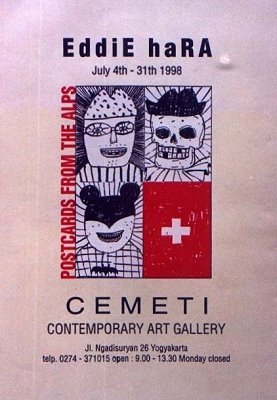
10. Eddie Hara
11. Heri Dono ("Wayang Legenda" and his painting artwork)
12. Photographic realism/surealistic tendency: Agus Kamal, Boyke Aditya, Nengah Nurata, Ivan Sagito, Sutjipto Adi, Lucia Hartiin, Linda Kaun (batik).
13. Cemeti Gallery: Nindityo Adipurnomo dan Mella Jaarsma

1990s
14. Dadang Christanto (from the exhibition of "Perkara Tanah")
15. Anusapati (object tendecy)
16. BINAL ART EXPERIMENTAL: Hedi Hariyanto and Kuda Binal Heri Dono
17. around pra and pasca Reformasi era: Agung Kurniawan and Hanura Hosea (critical artwork/social protest)
18. Abstract Expresionism: Made Sumadiyasa, Made Sukadana, Putu Sutawijaya, Nyoman Sukari.
19. Djoko Pekik: reformation trilogy ( Berburu Celeng, Tak Enteni Keplokmu, Tanpa Kabar dan Telegram Duka)
20. Noor Sudiyati (art craft)
22. Poetic Wildness: Ugo Untoro, S. Teddy D
23. Agus Suwage: self portrait and drawing charcoal
24. Komunitas Seni dan Budaya Taring Padi: Yustoni Volunteero dkk (posters and public art)
25. Iwan Wijono (performance "Manusia Hijau")

2000s
26. Apotik Komik group: Samuel Indratma, Bambang 'Toko' Witjaksono, Arie Dyanto, Popok Tri Wahyudi
27. I Nyoman Masriadi
28. Ruang MES 56: photography
29. Eko Nugroho and Daging Tumbuh (comic compilation)
30. Abdi Setiawan (sculpture)
31. Budi Kustarto (tendecy of new self portrait)
32. The House of Natural Fiber - Yogyakarta new media art laboratory: Venzha dkk
33. Yuli Prayitno
34. "Jogyapan-Jepangkarta" exhibition (expatriate): Seiko Kajiura
35. Yogyakarta Urban Art Movement: Arie Dyanto and friends (new public art, stencil art)
36. Sigit Santoso: the tendency of new internasionalism

Wednesday, August 09, 2006

Inadequate Urban Performance

A Note from the Performance Art Urban (Perfurbance)

A so called festival, simply held but performed foreign performers with even inadequate things was what I noticed from the whole day event of Perfurbance #2 on the last April 30, 2006. Perfurbance is an acronym of performance art and urban. It is an annual festival initiated by PerformanceKlub that is chaired by Iwan Wijono focusing on the development of performance art in Indonesia and managed by a group of youths. It was established on July 31, 2003 in Yogyakarta. Perfurbance presents performance art in public spaces in Yogyakarta and sends out actual issues on urban life.


The theme brought up by the organizer and approved by 27 performers of the event –two of them were foreigners from Australia and Japan– was “Launching: Education Industry in Indonesia”. The event was actually on the precise time which was a day before the ceremony of the National Education Day. It was strengthened by an article on a newspaper saying that,

Education in Indonesia has been distorted from the vision of Wiyata Mandala of which under the principle of Pancasila and UUD 1945, adapting the materialistic and business oriented system of the West. It is backed up by WTO and GATTS that in fact are organizations commercializing education as trade commodity to which Indonesia has ratified the agreement. Education becomes such a profit commodity not non-profit one. Consequently, it does not cause astonishment if education remains to be expensive and impossible to be cheap or free. [Certification for Teachers, Between the Problems, Policies, and Applications, Anton Eknathon, Kedaulatan Rakyat/KR, Wednesday, April 5, 2006, 10]

Unfortunately, the theme was not supported with thorough research by the organizer. I was not satisfied enough with the statement in the proposal presented in opting for education as the theme to this second event. To the core, a concern emerged was similar to the quotation above. As I confirmed this to both the organizer and performers, they did not give out a strong reason for its selection to public spaces. A performer, whom I interviewed with, Ronald Apriyan, preferred to perform his action without being put in fetters of certain theme frame [an interview with Ronald Apriyan, in Yogyakarta, Thursday, June 22, 2006). There was no discourse brainstorming between the organizer and performers on it so that the performance appeared to be unprepared but merely delivered a theme that education had became more and more expensive today. Moreover, some performers showed totally unrelated actions on the theme launched as Seiji Shimoda (Japan) or Sadat Laope & Fullskill Academy entitled “Picnic”.

It seemed that no strict curatorial applied in this event so that the organizer was capable of taking in as many performers as possible to take a part. On the record, the participation is noted great. There were 27 performers in the Perfurbance #2 increasing 10 number from the first event of 17 performers. It appeared to be a separate dilemma. On the one hand, the organizer aims to activate and popularize this art genre (performance art) in Indonesian visual arts so it may open a wide opportunity to anyone who wants to go into performance art. On the other hand, it can boomerang badly as the organizer has to allocate enough time, location, budget, and the most important is screening on the material of the actions.

On some occasions, performers ask for the involvement of public to support their actions like putting something down in writing, splashing paint, tying up the body, and even get involved or take a part in the actions. Yet, such public involvement is incidentally minimized by a kind of limitation with the arrangement of real classroom in the public spaces. The classroom is equipped with tables, chairs, and black/white board and ready to move out in accordance with the location spots utilized for the actions of the performers. Several performers had ever shared their disappointment to me since it was other performers who take a part in their actions not public regarded as common ones by them that are people who are watching or passing by.

As a matter of fact, if we look back at the idea put across by PerformanceKlub in holding this event is how to disseminate the performance art discourse in the art and non-art society, confronting the opinion that performance art is simply the mediation from demonstration activities and re-socialize performance art (contemporary) in public spaces. This event also aims to criticize and stimulate Yogyakarta as an urban city getting more and more incapable of accommodating arts in the public spaces or even the lesser public spaces available for its society. It is also to stimulate the society to think and catch sight of its life in an urban city.
Perfurbance was initiated last year, on March 30, 2005 to be exact. Both the first and second organizer take the same location that is in Malioboro Street but the Perfurbance #2 adds one location that is in the side parking area at Shopping Book Center.

Why is Malioboro? From the press release issued by the organizer, it is opted for its development context regarding the fact that Yogyakarta is inseparable from the growth of Malioboro. Varied images adhered to Yogyakarta in general is identified from the daily occurrences in Malioboro. It is not only due to its site in the city center and as the icon of Yogyakarta but it is because of Malioboro is the central point of many targets from the existing factors. Economic factor is represented by a lot of activities with numerous sellers and stores and political factor is represented by many accessible government offices beside of another considerable and observable factors such as social, culture, and education.

Why does the organizer take the same location for the second event? After being examined from a short discussion with the organizer, it is founded out that the bureaucratic procedure, the easy access to obtain permit to utilize a public space become the reason behind. Several different sites have been the upcoming targets for this second Perfurbance such as Taman Makam Pahlawan Kusumanegara and the porch/front area of Lembaga Pemasyarakatan. However, the organizer should feel satisfied to present it in Malioboro and its surroundings where is relatively easy to get the permit.

The selection on location becomes my question to the organizer as a discussion held in the series of the event a day before the action, May 1, 2006 at Taman Budaya Yogyakarta (TBY)/Yogyakarta Arts Center. A discussion under the theme of “Implikasi Edukatif dari Performance Art di Ruang Urban Publik” presented Jan Cornall (Australia), Kusen Alipah Hadi (Yayasan Pondok Rakyat/YPR, Yogyakarta), dan Seiji Shimoda (Japan) as the speakers.

Do all these performers really need exterior media to present their actions? Looking back at the Perfurbance #1 last year, the organizer gave an option to all performers whether to perform indoor (at that time at Kedai Kebun Forum/KKF, Yogyakarta) or outdoor. Thus, performers were able to consider how and where the actions powerfully presented by taking into account the rooms provided. At this time, the actions are all outdoor. In my opinion, some actions performed like one of Group Retorika entitled “Buying Money” is not powerful to be performed outdoor. On some occasions, Iwan Wijono acting as the organizer, performer, as well as master ceremony at that time asked public to get closer to the performers since they were wearing properties needed to be seen in detail.

Several questions come to my head after having the explanation above. One to raise is related to the organizer which could not be answered properly and might not be answered by the time. How can we measure the indicator of material achievement presented through the performance art media understood by public? How do the performers comprehend the awareness on public spaces after having two same events which utilize the same space or location? What are the issues faced by public in the urban public spaces as Yogyakarta today? What is the improvement or concern changing and issue to be learned from the last event in the public spaces such as Malioboro? It might be as what Jan Cornall conveyed in his paper for the discussion,

Performance art is generally more mysterious and inexplicable. In fact its impact is greatest when it cannot be explained. It's impact then, is to WAKE UP urban space. The audience experiences a kind of shock which radically affects for a spit second or more, the way they view the urban space around them. The imagery created by the performer enters the viewers dream consciousness and will be processed like a dream: understood, interpreted or simply left to its own devices, to surface later in another dream or action. This is the way performance art educates. [ Dreaming the Urban Body The Impact Of Performance Art in Urban Space, by Jan Cornall, Yogyakarta, May 1st, 2006].


Performers: Yustoni Volunteero “Menabrak Tembok Tak Kentara” - Danny Stamp “Mind War” - Garis Merah “PT. Kerajinan Ijazah” - Buyung Mentari “Tabur Tengah” - Elyandra “Ceremony” - Bocor Alus “I Want Candy” - Lashita Situmorang & Tere “Ayo Sekolah - Instant” - Group Matjam (Yoyojewe & Kholik) “Time Is Nothing” - Coklat “CBSA (Cara Belajar Siswa Aktif) Malas, Miskin” - Ronald Apriyan “Magazine” - Yayan Hariansyah “Boneka Neo Liberalisme” - Sadat Laope & Fullskill Akademi “Piknik” - Alim Bakhtiar “Pelajaran Ruang Kelas” - Iwan Wijono “Rock Education & Roll Money” - Hamzrud “So What” - Made Suryadarma “Instant Education” - I Kadek Dedy “Rupa Kata” - Group Retorika “Membeli Uang” - Ismanto & Suku Gading Mlati “Konyol” - Oentoeng, Sentot, Kris Toples “E=MC 2 – Relativitas - Whatever That Means” - Pitut & Group Bim Sala Bim “Pelajaran Menulis” - Soge Ahmad “Pedagogi Statis” - Santo Klingon “Melody Darah – Belajar Bermain” - Shiori Shimizu “Di Atas Orang” - Jan Cornall “Bulls Eye Mudra” - Seiji Shimoda “………………..” - Cutter “School Make Up”


Published:

http://www.resartis.org/index.php?id=42&tx_ttnews%5Btt_news%5D
=493&tx_ttnews%5BbackPid%5D=30&cHash=7f6df2d182

Tuesday, July 18, 2006

Kembali Djokdja Kembali

An exhibition on art documentation in Yogyakarta in the last 32 years entitled “Kembali Djokdja Kembali” was held at Museum Benteng Vredeburg, Yogyakarta, September 29-October 3, 1999. It was the collaboration of Cemeti Art Foundation, [aikon!], Kebon Binatang Art Support, Rumah Budaya Semesta, Ford Foundation, and Museum Benteng Vredeburg.

Introductory Citation
An approximation of 300 documentation; posters, catalogues, tickets, clippings, photos, and leaflets will be presented in the exhibition. Certainly, this number is not fairly fantastic as there are a lot of art events in Yogyakarta in the last 32 years. As a result of the limited time, not all of the art event documentation can be obtained. However, we strive for not basing the exhibition material on the monumental phenomena regarding something considered “monumental” will not mean anything without the side of “not monumental”. They all have the same importance in the process of art in Yogyakarta but unfortunately, very few people taking the role of recorders toward all cultural events. History is then associated more through the oral tradition relying on memory. It is one of obstacles we face.


Difficulty in Tracing Document!
(A Note from the Research Team)
By Nunuk Ambarwati and Jompet
A Researcher of Musical Printed Documentation

For almost 2 months of going back and fro to search for posters, catalogues, tickets, and so on in the field of music, I encountered some points. According to me, comparing to colleagues from theater or visual arts, the music artists rarely collected posters, tickets, or invitations. They assumed that they did not need collecting them. Most of them said “Say, the posters are entirely distributed!” since posters functioned as publication media to be distributed or stuck and just got passed on or torn in the streets at last. Sometimes, some artists were reluctant to collect them because the design was not attractive. The awareness to collect them as documentation was not deep among music artists. If any, there was only one or two of them who documented his debut attentively. Even, there were some artists whose documentation done by the mothers, wives, or fans.
Another issue from this searching was the reluctance of the resource artists to lend some of their documentation with the reason that the duration between the due day and the exhibition day was quite far. They lent them closing to the D day. It related to the issue of documentation security or the fear of damage. There were also some artists who made a curation on their own documentation regarded as important. In reverse, it did not mean that some documentation they did not give to us were unimportant, did they? Sometimes, when I came the artist was taking a trip abroad in unpredictable time or studying abroad. They were even out of contact or deliberately to be out of contact. Gee, it was resentful! There was a touching moment, an important one like “agreement of artists in… making an option toward the government” considered as historical but the artist who collected the documentation had passed away. So, it could be presented orally only.
In conclusion, our documentation searching had not reached all music genres in Yogyakarta. It was because of the limited time, no documentation of artists at all, and the individual capability. Sorry! However, the people involved in this project were basically welcome and supportive meaning that they could see the idea was magnificent and raised the awareness on the importance of documentation.

Issued in the exhibition catalogue 32 Years Yogyakarta Art Documentation “Kembali Djokdja Kembali”, Yogyakarta, 1999,
page 4-5

Tuesday, July 04, 2006

Mendokumentasikan Seni Kontemporer di Asia


Workshop Internasional: “Archiving the Contemporary: Documenting Asian Art Today, Yesterday and Tommorow” diorganisir oleh Asia Art Archive (Hong Kong), 18-20 April 2005.
Menapaki bandara Hong Kong yang megah, saya membayangkan bagaimana sebuah workshop mengenai dokumentasi seni visual di Asia akhirnya terselenggara pula. Cemeti Art Foundation (CAF) sebagai lembaga dokumentasi seni visual Indonesia akan bertemu dengan berbagai lembaga atau individu lain yang mempunyai perhatian dan minat yang sama. Event ini diorganisir oleh Asia Art Archive (AAA), sebuah pusat riset nonprofit pertama di Hong Kong yang berdedikasi untuk mendokumentasikan sejarah seni visual terkini dalam skala regional dan internasional. AAA bertindak tidak hanya sebagai pusat data dan informasi, tetapi juga berperan aktif dalam mengorganisasi dan berpartisipasi dalam pameran dan forum-forum budaya serta menyediakan diri sebagai penghubung untuk semua hal tersebut di wilayah Asia. AAA didukung secara finansial oleh Hong Kong Arts Development Council.


Workshop berlangsung 3 hari, 18-20 April 2005 di Hong Kong Arts Centre. Event ini menjadi tempat berkumpul bersama para pekerja profesional di bidang seni dari seluruh dunia untuk melihat isu-isu mengenai mengarsip, mendokumentasi, pemeliharaan/perawatan, pengetahuan manajemen, dan berbagi informasi mengenai seni kontemporer di Asia. Cara atau model mengarsip yang selama ini sudah ada akan diuji dalam forum ini, dan ditambah isu mengenai digitalisasi versus materi hardcopy, sistem klasifikasi, kewenangan atas koleksi, konservasi, bahasa, askesibiltas dan teknologi, juga dibicarakan dalam forum ini. Harapannya, workshop ini dapat memfasilitasi, dan sebagai sebuah platform lain adalah peserta workshop saling bertukar gagasan dan pengalaman, serta mengembangkan kolaborasi dan jaringan di masa mendatang.
Workshop ini juga merupakan sebuah respon atas seriusnya permasalahan mengenai percepatan perkembangan seni visual kontemporer di Asia dan di seluruh dunia dalam kurun waktu dua dekade terakhir ini yang tidak dibarengi dengan jumlah dokumentasinya. Bagaimana pun pentingnya perkembangan tersebut, hanyalah sebuah pusat yang sibuk di mana informasi dan riset mendalam, wacana dan tulisan kritis di area itu saja yang bisa ditemukan. Pentingnya Arsip Seni Kontemporer dari Asia untuk Masa Mendatang Diambil dari bahasa Yunani kuno an arkheia, tujuan dari kegiatan mendokumentasikan adalah untuk menyimpan ingatan publik di mana bentuk itu merupakan basis administratif dari demokrasi, yang tidak lagi merupakan inti dari aktivitas tersebut. Material dokumentasi itu sendiri membutuhkan untuk direspon tetapi juga tetap bisa proaktif dengan berbagai tempaan model pendokumentasian yang baru. Saat ini, ketika museum mempunyai tujuan untuk menarik lebih besar audiens dengan sesuatu yang lebih inovatif, atau membuat hubungan yang dinamis antara karya seni dan lingkungan mereka, dokumentasi seharusnya juga mengubah strategi untuk menentukan tujuan, dan membuat penggunaan yang lebih baik dari materi dokumentasi atau koleksi mereka. Untuk dokumentasi seni kontemporer yang ada saat ini, merupakan hal vital untuk membuat strategi agar materi dokumentasi lebih dinamis. Dengan alasan ini juga, program-program menjadi lebih relevan dan sejalan dengan aktivitas mereka. Ini merupakan pendekatan yang dimanis untuk kegiatan dokumentasi di mana akan memiliki tempat penting untuk seni kontemporer di Asia dan beberapa bagian di dunia. Esensi mereka untuk merekam akar-akar kebudayaan dan keberagaman belum dapat diadaptasi secara simultan untuk menekan dan memberi perhatian kepada hubungan kesejarahan. Dokumentasi akan berperan penting membangun jaringan pertukaran komunikasi dan informasi di Asia mau pun di luar Asia. Di sini ditekankan isu dan kritik mengenai banyaknya kebutuhan platform di Asia mengenai pengetahuan manajemen dan berbagi, serta menyediakan sebuah wadah di mana tersedia acuan mengarsip dan data-data untuk seni kontemporer Asia. Sebagai jumlah yang tidak bisa diprediksikan, berapa banyak seniman di Asia yang terlibat dengan pendekatan multimedia untuk karya mereka dalam dekade lalu, seperti instalasi, digital dan performance? Workshop ini kemudian juga menyentuh isu konservasi dari karya seni nonkonvensional dan bagaimana hal ini meliputi pekerjaan seorang dokumentator. Workshop ini juga melihat tambahan peran dokumentasi sebagai pembangkit pengetahuan dan informasi. Dipertemukannya berbagai organisasi yang mempunyai tujuan hampir sama, bersama-sama untuk membentuk kerja sama yang kuat, sekuat membangkitkan inisiatif di negara-negara di mana pusat dokumentasi belum ada. Mereka menyatakan bahwa peran penting pendokumentasian adalah untuk menyediakan informasi yang berhubungan dengan karya-karya seniman, dan untuk siapa saja yang berperan penting dalam meningkatkan pengetahuan serta kepedulian tentang seni kontemporer di wilayah regional.
CAF versus MoMA

Mendapatkan kesempatan presentasi di hari pertama, memberi keuntungan tersendiri buat saya sebagai representatif Cemeti Art Foundation (CAF). Hal ini mempermudah proses interaksi saya dengan peserta workshop yang lain dalam 2 hari yang tersisa. Banyak yang tertarik untuk ngobrol lebih detail mengenai materi presentasi yang saya ajukan, dan tentu saja saya masih punya waktu lebih banyak untuk melayani keingintahuan mereka mengenai CAF.
Duduk satu meja dengan Michelle Elligot (representatif Museum of Modern Art/MoMA, New York) dan Edward Tse (Hong Kong Film Archive, Hong Kong), presentasi kami berada dalam satu tema mengenai “Save or Destroy: Preservation and Collection Policies”. Penyelenggara memang sengaja mempertemukan kami karena ingin memberikan pembanding kepada audiens, dimana MoMA dan Hong Kong Film Archive memperlakukan material dokumentasi mereka seperti layaknya koleksi museum: hanya bisa dilihat dan tidak mudah diakses. Adapun CAF justru sebaliknya, karena CAF berusaha “membunyikan”, mendistribusikan dan menyediakan akses seluas-luasnya kepada publiknya.
Audiens cukup heran dengan bervariasinya jenis material yang didokumentasikan oleh CAF, sistem aksesibilitasnya yang begitu mudah dan luas, serta pola jaringan yang dipakai CAF untuk mendistribusikan material dokumentasi baik level nasional maupun internasional. Demikianlah presentasi ini memberikan gambaran situasi, cara memperlakukan material dokumentasi dan kewenangan atas koleksi yang masing-masing berbeda di setiap lembaga.

Topik bahasan lain

Workshop ini memberikan berbagai pandangan baru, terutama bagi saya, tentang pelbagai kemungkinan mempresentasikan material dokumentasi tidak melulu sebagai arsip tetapi dalam sebuah setting pameran, seperti dicontohkan oleh Thomas J. Berghuis (Australia) dan Beatrice von Bismark (Jerman). Bismark mempresentasikan sebuah proyek pameran dan publikasi bertajuk “Interarchive”, sebuah pameran arsip yang berangkat dari arsip dan menyediakan contoh dari pelbagai model, di mana unsur artistik dan kultural merefleksikan dan berpartisipasi dalam proses mengkonstitusi.
Claire Hsu (direktur eksekutif AAA) mengembangkan isu mengenai kesempatan dan perhatian yang dihadapi sebuah lembaga dokumentasi independen yang dibentuk untuk merespon situasi perkembangan seni visual di wilayahnya. Isu ini mempertimbangkan pula masalah geografis, pengembangan jaringan dan relasi di wilayah regional, masalah koleksi, manajemen dan pendistribusian informasi melalui bentuk hardcopy maupun melalui dunia maya. Dokumentasi tidak hanya dimaknai sebagai sebuah materi rekaman, tetapi bisa mendorong secara aktif dalam memproduksi gagasan.
Workshop ini juga mempresentasikan berbagai model pendokumentasian yang dikerjakan oleh individu-individu seperti dicontohkan oleh Yao Jui-Chung (Taiwan), Judy Freya Sibayan (Phillipines) dan Koh Nguang How (Singapore). Masing-masing individu tersebut membangun personal dokumentasi mereka dengan cara mereka dan minat mereka masing-masing. Seperti Judy Freya Sibayan, seorang seniman asal Phillipines, mengakumulasikan material performance-nya sepanjang 5 tahun ke belakang dan ke depan. Material dokumentasi tersebut dimasukkan dalam bentuk kantong-kantong sepanjang 4-9 kaki dibagi menjadi 24 ‘buku” dan dikategorikan berdasarkan cerita. Materi dokumentasi ini juga akan menjadi sebuah karya seni dan akan dipamerkan suatu hari nanti. Dengan format ini Judy menyebutnya sebagai Scapular Gallery Nomad Portable Archive in Progress.

Epilog

Di balik mewahnya penyelenggaraan workshop ini, ternyata peserta dan penyelenggara masih menyisakan sejumlah pekerjaan rumah sebagai tindak lanjut dari workshop ini, yaitu tawaran dari AAA sebagai penyelenggara: apakah perlu suatu lembaga yang menjadi pusat pendokumentasian di wilayah Asia atau tidak? Semua peserta workshop sepakat, pentingnya dokumentasi seperti diutarakan dalam uraian di atas, serta pentingnya jaringan untuk menyediakan dan saling berbagi informasi dan data dokumentasi seni visual di wilayah Asia.

Dimuat di newsletter SURAT YSC Volume 26

Saturday, June 24, 2006

Tolerance of Nindityo Adipurnomo


Yogyakarta, pretty hot today! 2001
Dear Ian,It doesn't feel like I've been working at the gallery (Cemeti Art House) for two years now. Hey, quite a long time, honey! Do you think it's long time? When I first started working there, Ndit was rather awkward with me, but it turned out he doesn't find it easy to mix with people, especially people he's never met before. He says he uses the yin and yang principle (Friday, September 13, 2001). Using that principle worked out in the end. Lots of joking around! Remember the time he was so amazed and laughed at himself? When he was still using 'the finishing touch' tehcnique so he could complete a watercolour in one day. So what? (Saturday, September 22, 2001).


Well! Have you ever thought about what would happen if no one was interested in or talked about Ndit's work anymore? He says my question is abstract, so there are lots of possible answers. But he seems really optimistic, he says that's the way it is in fact, that there's not much interest in his work here (in Indonesia), so for him it's not a problem. "If, let's say, the situation really was like that, well... it would mean I'd be 'dead', he said. But he doesn't believe that an artist's creativity diminishes or dissappears, an artist will always create something new. That's why it's not a good idea to have a 'trademark', because when the 'market' doesn't like it anymore, well... then it won't sell. (Sunday, September 16, 2001). What about you, Ian? Do you like his work?

The strange thing is, he doesn't have an obsession about art! Because he doesn't want to get trapped in the situation where art is the only reality, when in fact art is only a small part of reality. For him life is art and he realises that art is a reality of life itself. (Wednesday, September 19, 2001).

If you think about it, Tono asked a great question that evening too, one I'd never thought about before. Tono said, lots of Ndit's works use elements of Javanese tradition, but why was his wife a foreigner? Aha?! He calmly replied, "You cand work that one out of yourself". Okay, so that's a personal question. (Saturday, September 22, 2001).

Ian, do you think Ndit is a succesful artist or not? He would say that he doesn't feel he's success yet. If he did, then he'd be 'dead'. He think that each artist must have his or her own yardstick. An artist's interaction with different people can take many forms, it might be spiritual, or exchange of ideas, whatever. If success in this sense is the goal, then it's up to the artist. If this interaction really takes place, then the artist could be called a success, he said. Perhaps his answer will be different in five years time. (Sunday, September 22, 2001).

Oh... sometimes I feel so bored working there, I want to get far away and just do whatever I want every day. Yes, do whatever I want! Like Ndit did one day with Sae and Yona when he was bored. They just played with soap bubbles for three hours on the top of the Gading gateway! Well? He says he's always trying to return to the real concept of life. The way to stop feeling bored is to do something different, something that you didn't think you'd enjoy doing or something that's not related to your work. Then you'll start and then you'll miss your work. Unfortunetely, I'm not the boss like he is. (Friday, September 28, 2001).
With love, Nunuk

Note from Nindityo Adipurnomo:
Nunuk (1976) lives in Yogyakarta. When I returned from my residency at Cardiff (August 1999), Nunuk had already started working at Cemeti Art House. It was at that time Nunuk and Ian (Nunuk's close friend) eagerly began "forcing" me to get to know the cyberworld and all its ins and outs. I thoroughly enjoyed it.

Published at "Tolerance/Toleran", Nindityo Adipurnomo, publisher: Nindityo Adipurnomo, Yogyakarta, Januari 2002, p.14-15

Wednesday, June 07, 2006

Earthquake in Yogyakarta and Storm in Tainan


Yogyakarta, Saturday, 27th May 2006, 05.55 hrs
I was dragged out of the house by my younger brothers and my father. Screaming with panic, confused and tense, we managed to save ourselves from the terrifying tremors of the quake that measured 5.9 on the richter scale that shook Yogjakarta and it's surrounding areas, on Saturday morning, the 27 May 2006.


Electricity and all ports of communications shut down within seconds of the quake, and left us almost completely isolated from information on what was happening. Only one local radio station remained active and willingly became a port exchanging information for almost all of Yogjakarta. Every two hours after the quake, we still felt tremors, although nothing compared to the first. Even as I write this, the tremors still occur and can be felt very strongly in certain areas of Yogjakarta.


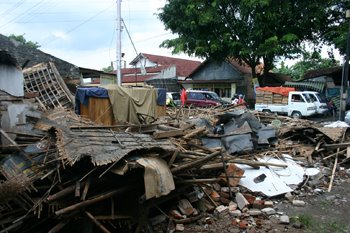
What happened as a result? While we were lucky that there were only cracks here and there in my house, my neighbors' homes, to both our left and right, were totally destroyed. But I only really realized how disastrous the impact of the terrifying quake was after I'd gone around the city of Yogja hours later. In less than a minute, the earthquake on Saturday morning had destroyed thousands of buildings and public facilities like schools, government offices, old cultural and heritage buildings, like temples and of course many residential homes. Many people were injured by debris falling from collapsing houses, and there have been more than 5000 casualties. The sight of streets and mosques filled with bodies, hospitals crowded with casualties, from mostly broken bones and bruises, and people who don't know what they will do because they have lost their homes, is overwhelming. The weekend quake was really like an 'attack at dawn', which shocked all of us who live in Yogjakarta, and has left behind a deep trauma. Most choose to sleep outside and to stay awake in case a bigger tremor happens. Even the patients at the hospitals prefer to stay in the outdoor compounds of the hospitals rather than to be moved to the wards.
When all attention was directed to the heightened activity of Mount Merapi in the north of Yogja, the unexpected disaster came from the south, a tectonic earthquake, the aftermath of the collision of two Indo-Australian and Eurasian plates.

Gempa di Yogyakarta dan Badai di Tainan
Yogyakarta, Sabtu, 05.55 WIB
Belum habis sisa kantuk semalam, saya dipaksa bangun dan diseret adik laki-laki dan ayah untuk segera keluar rumah. Sambil berteriak-teriak karena panik, bingung dan tegang akhirnya kami berhasil menyelamatkan diri dari dahsyatnya goncangan gempa berskala 5,9 Richter, Sabtu pagi, 27 Mei 2006 di Yogyakarta dan sekitarnya. Di luar, semua orang sudah keluar rumah menunggu goncangan gempa mereda. Aliran listrik langsung padam, sarana dan prasarana komunikasi sesaat terputus, kami terisolasi informasi. Waktu itu hanya ada satu radio lokal yang aktif menginformasikan terus perkembangan yang terjadi. Radio lokal tersebut mampu menjadi sarana bertukar informasi hampir di seluruh pelosok Yogyakarta.

Sekitar setengah jam sesudah gempa, kami masih dikagetkan atas isu tsunami yang menghantarkan ratusan orang berkendara motor, dari selatan berduyun-duyun menuju utara, ke daerah yang dianggap lebih aman. Beruntung hal itu hanya isu belaka, sehingga situasi dapat segera diatasi. Belum cukup sampai di situ, setiap 2 jam kami masih harus menghadapi gempa susulan walau pun skalanya tak sebesar gempa pertama. Bahkan hingga tulisan ini saya buat, gempa berskala di bawah 3 skala Richter masih terus terjadi dan kadang dirasakan sangat kuat di beberapa wilayah tertentu di Yogyakarta.

Apa yang terjadi? Rumah saya memang hanya retak di sana-sini, rumah tetangga kiri dan kanan saya ternyata roboh. Tetapi saya baru betul-betul menyadari dampak kedahsyatan gempa, setelah sempat berkeliling kota Yogya beberapa jam sesudah gempa. Tidak sampai semenit, gempa Sabtu pagi itu telah meluluh lantakkan puluhan ribu bangunan fasilitas publik seperti sekolah-sekolah dan gedung pemerintah, bangunan warisan budaya seperti candi-candi dan peninggalan masa lalu, tidak terkecuali pula dengan rumah-rumah penduduk. Melukai puluhan orang karena tertimpa reruntuhan rumah mereka bahkan membuat lebih dari 5000 jiwa melayang menjadi korbannya. Pemandangan memilukan menghiasi masjid-masjid mau pun pinggir jalan saat dijajar beberapa jenazah, rumah sakit-rumah sakit disesaki para korban yang sebagian besar patah tulang dan luka memar, mau pun penduduk yang tidak tahu harus bagaimana karena kehilangan tempat tinggal mereka.

Gempa di akhir pekan itu memang seperti ‘serangan fajar’ yang sangat mengejutkan bagi kami semua yang tinggal di Yogyakarta dan menyisakan trauma yang mendalam. Sebagian besar lebih memilih tidur di luar rumah dan berjaga-jaga kalau-kalau ada gempa susulan yang lebih besar. Bahkan pasien-pasien yang ada di rumah sakit pun lebih memilih ditempatkan di pelataran luar rumah sakit daripada harus pindah di bangsal ruang dalam.

Selama tinggal di Yogyakarta, kami memang tidak asing dengan gempa kadang terjadi. Tetapi gempa Sabtu lalu disamping skalanya sangat besar dan berpotensi merusak, semua pihak merasa kecolongan untuk kali ini. Di kala semua perhatian tertuju atas meningkatnya aktifitas Gunung Merapi di Yogya bagian utara, bencana malah datang dari selatan yaitu gempa tektonik, akibat bertumbukannya dua lempeng (patahan) Indo-Australia dengan Eurasia.

Aliran empati
Sebagian besar wilayah di Yogyakarta masih lumpuh hari pertama dan kedua pasca gempa, kesulitan evakuasi karena banyaknya korban, matinya aliran listrik, juga matinya perekonomian. Setelah menjadi headline di beberapa media massa cetak mau pun elektronik karena Gunung Merapi, kali ini Yogyakarta kembali menjadi headline atas kejadian gempa tersebut. Sama terhenyaknya dengan banyak sahabat baik dari luar Yogyakarta mau pun dari luar negeri, beberapa pesan singkat (SMS) mau pun email segera mengalir menanyakan kondisi kami, seperti “are you ok?” atau “bagaimana Yogya?”, “thinking of you” dan seterusnya. Semua tergerak memberikan bantuan dalam berbagai bentuk membanjiri kota Yogyakarta tiada henti. Posko-posko segera didirikan di hampir semua titik bencana dipenuhi logistik, tenda, pangan, obat-obatan, tim medis, relawan dan sebagainya. Pengalaman di Aceh dengan tsunaminya, lebih dari setahun silam, membuat pemerintah Indonesia sendiri cukup sigap menghadapi bencana kali ini. Berbagai strategi penanggulangan bencana mau pun pasca bencana segera dilakukan sebaik-baiknya, walau pun tetap dirasakan kedodoran di sana-sini.

Dua situasi berbeda
Belum berapa lama saya kira, ketegangan dan kepanikan yang berbeda dalam menghadapi bencana masih ingat betul di benak saya. Hal tersebut menjadi satu hal yang menarik dan memperkaya pengalaman kehidupan saya. Dalam suatu kunjungan saya di kota Tainan, Taiwan tahun lalu, 3 hari diantaranya saya harus berhadapan dengan badai besar yang sebelumnya tidak saya jumpai selama saya tinggal di Indonesia. Badai angin disertai hujan yang mampu membuat beberapa pohon tumbang, beberapa bangunan rusak, dan mampu menyeret orang besertanya, membuat saya sempat panik apalagi jauh dari rumah dan orang-orang yang saya cintai. Namun kepanikan itu mampu diredakan dengan sikap tenang semua penduduk Taiwan kala itu, karena pihak berwenang sudah mensosialisasikan akan datangnya badai dan semua hal yang berkenaan atas hal itu. Sehingga ketika tiba hari H, semua sudah bersiap diri sehingga tidak jatuh banyak korban mau pun kerugian material yang besar. Seandainya hal tersebut juga berlangsung Sabtu pagi yang lalu, tentu teman saya tidak akan kehilangan orang tercintanya karena meninggal tertimpa reruntuhan bangunan, walau pun tetap banyak bangunan akan roboh karenanya.

Yogyakarta, 06-06-2006
Nunuk Ambarwati

Published:
http://www.aaa.org.hk/newsletter.html#news313

Sunday, May 21, 2006

ORDE and ORDER: Which One is Powerful?


The exhibition entitled “Orde and Order” was held by Cemeti Art Foundation (CAF) from May 5 until June 5, 2006 at Kedai Kebun Forum (KKF), Yogyakarta. It attempted to show data, archives, visual and audio visual material on ideological arena by the rulers (either the government or capital holders) in Indonesia, the relationship between artists and the rulers, the model of relation among artists, public, and the rulers entirely using art as the media. The media used and socialized could be very massive and –whether we realized it or not– had affected personal areas from each of us.


The model of power consolidation, the formation of nation-state identity, the economy development, and the social political relation are all the models of layers systematically repeated in every Indonesian government and each grows varied expressions including one in the form of cultural products. How does the power work and present in the art works or cultural institutions from time to time? How is the operation of power conflicted with the personal values of artists? How do the artists consume the power and manifest it in their art works consumed by public? How do these people make an interpretation on the political ideology of changing policy?
On the record, it is noted that CAF has organized a variety of contemporary visual arts exhibitions originating from the output of workshops, research, and art works as well entitle “AWAS! Recent Art from Indonesia” (1999-2002), “Tali Ikat: Fiber Connection” (2002), and “Fixing the Bridge” (2003). The “Orde and Order" is the first exhibition held by CAF using the archives or documentation data collected by CAF. It is an authentic attempt done by CAF as a center for visual arts documentation for more than one decade (established in 1995) to mediate the outcome of historical reading based on archives in a visual arts exhibition. With our sincere expectation, we think that the society may comprehend the meaning, function, and importance of documentation rites from which can be elaborated into several outputs with various alternative possibilities.

One of the activities under “Orde and Order” held by CAF was to organize a discussion in the same theme on Saturday, May 6, 2006 at KKF, Yogyakarta. This visual arts exhibition originated from archives or documentation had offered highlights (focuses) into how the role of power emerges in the sub-topics in architecture, audio visual (films), uniforms for elementary and high school students, ceremonial rites, and re-gave meaning on pictures and messages through the designs of stamps and currencies. There were three presenters in the discussion; Mahatmanto, a lecturer of architecture at Universitas Kristen Duta Wacana (UKDW), Yogyakarta, Primanto Nugroho, a researcher and manager of Nandan Institute of Art Studies (NIAS), Yogyakarta, and Ifa Isfansyah, an activist of Four Colours, a community of filmmakers based in Yogyakarta. It was moderated by Agung Kurniawan, an artist and manager of KKF, and was quite warm although it had very few audiences. Agung led the forum on the discussion around the role of power; in this context was the state or capital in relation to the visual arts workers. Here is the writing compiled, from the forum completed with a short interview with Pius Sigit Kuncoro (Sigit) as one of curators in the exhibition.

The discussion was opened by Mahatmanto presenting the history of the model of power relation in the past until today in architecture. He said that the visualization of cities and architecture was not determined by the state or the ideology ruling at that time but by another authority ruling the production. For example, in the transition of Hindu to Islam, the period did not produce much difference of representative visual productions. Today, we enter a time with such complex relation. From there, I wanted to illustrate that in fact, not only in that time the hidden force worked but also in recent time. Who was this hidden force? It was easy to point out the capital but how it operated was never clear. The position of architect here was regarded as weak, marginalized, and performed to give shapes only. So, it did not change anything except for the surface. What kind of structures produced during the independent time or the early Old and New Era? As we liberated from the Dutch colonization, the first thing done was to establish a partial entity called Jakarta as a special district. From there, various works were carried out as the representation of nation building. In the early independent time, architects oriented toward one or two prominent figures with certain architectural ideology indeed that was to search for identity by looking for the essence of huge diversity. It was different from the time under the New Order in which the figures were repeatedly modified but the operation remained unchanged. In addition, there were particular figures ascertained the themes of architecture. Then, the international style was followed to project an image of modernity in the cities. In the New Order time, within which capital was in power, the architecture tended to be mercantilism. It was signified by the architecture of offices in large numbers and styles. (For details, read the paper written by Mahatmanto entitled “Pahlawan di Jalan-jalan”/Heroes in the Streets).

Another experience shared by Ifa Isfansyah who had been active in the film industry since 1999, occupied her with producing films in 2001 along with her colleagues associated in the Four Colour community, and acquired some orders from the government from 2003 until now. There were four film productions released dealing with the government profile and public service advertisement. However, Ifa and her colleagues did not acquire the orders directly from the government so that it could be said that she did not straightly interrelate with the government, the one giving the orders. There was such an agency pointed by the government to manage the orders. In her presentation, Ifa stated that she was freer to run the productions when she worked on a government order because the bureaucratic procedure (such as the permit to make use of particular locations) would be easier. Yet, by the time she was asked about her satisfaction as a filmmaker, she said that working with non-government institutions was more interesting because the aspiration and creativity could be deeply comprehended and aspired. It frequently appeared as a specified dilemma for the visual arts workers.

Primanto Nugroho started on his presentation with a question on how to give a meaning on power. What we could see in the representation of “Orde and Order” was relatively in the same structure that was a point to identify power and the rulers. Hence, in the forum, Primanto reminded us not to exclusively identify power as mere physical, militaristic, of arms, and the sorts but power of knowledge and power of capital; how their state of affairs and operation were. To make it clear, Primanto gave an example on the phenomenon of uniform massiveness in the designs and colors for elementary and high school students in the decade of 1980. Different analysis could be applied to this uniformity program under the New Order through uniforms, what ideology behind it was, and so on. This uniformity program in the 1980s was employed due to the overflow of unsold textile (for export) whereas it had to be produced continuously in the country for domestic needs. (For details, read the paper written by Primanto Nugroho entitled “Satu Ragam Pakaian dalam Keseragaman”/One Variety of Clothing in Uniformity).

Subsequently, the flow of discussion revealed how the power of knowledge and the power of capital set the background of image creation or outer shell of which its visualization considered unexposed in this exhibition. How did they pull each other between the power of knowledge and the power of capital? It was a package of power relating and influencing each other, how if the power of capital was stronger than the power of knowledge, and the contrary. For instance, in the era of Soeharto, the power of knowledge was weaker than the power of capital contradicted with the era of Sukarno. In an interview with Sigit, he said that this exhibition purposely avoided the topic of identifying non-physical power (like the power of knowledge and the power of capital) which was abstract, so fluid, changeable, and so dynamic instead of the limited time. Sigit even strengthened how these physical materials exhibited functioned as the assets to seek out the relation model of power and orders, the model of conspiracy acted setting in further. It surely required a separate research.
On the quotation of the welcome speech by Sigit, the exhibition was to present the archives of documentation on a number of art programs held instead of performing the visual art works which were the orders of the state to the art workers. It aimed to show the reality in the friction of opinions and consciousness between the state and society revealed from the time of state establishment until today. From the reality, it was expected that we could locate the indecencies affected by the state’s orders in penetrating the idea of identity and national ideal to the society. The aroma of importance from the domination of certain groups toward others was extremely noticeable so that every time the succession of the rulers approached, there were varied questions on the national identity and ideal.

Apart from some core findings on the exhibition arrangement, there are several points to refer to:
First, the exhibition aims to demonstrate the importance on the role of visual arts workers in campaigning the vision, mission, national identity, and image creation by the state by means of visual arts media. It also deals with the tendency of having visual art workers anonymous (though it cannot be generalized) from their works in the name of the state and nation. How if these visual thoughts was effectively applied simply “on the sheet” of works of the visual arts workers but in fact they are not influential enough in realization as they are not based on the real needs of the society, barely mere penetration of the state in the society.

Second, the strength and effectiveness of visual arts media as well as public spaces to unify and strengthen the nationality and national identity, the ideal image creation, and the opinions in plural and multifaceted society like Indonesia.

Third, it is important to say that through this exhibition CAF as the center for Indonesian visual arts documentation constantly intensify the public awareness on the benefits of archives or documents capable of giving a guidance in exploring historical traces and determining abstract statements. For instance, when the material of visual arts under 1960s definitely should be presented to support the exhibition but the archives or documentation at CAF commenced from the 1990s does not apply the situation. Consequently, lots of materials “are hunted” from other sources.

Fourth, despite the dominations mentioned above such as the state power (government), the power of knowledge, and the power of capital; we should notice the militant domination moving through various segments taking a part in the formation of multicultural Indonesian national identity. The rulers –whoever and whatever the forms are– use their authority and power to create ideal image. Here, the visual media and public spaces are effective instruments and vehicles to the achievement of image and opinion creation in the society.

Fifth, the attempts of image creation is critical to notice especially when it relates to the public importance and area with the purpose of keeping the government’s orders –both capital and authority– for certain classifications do not become a means of public untruths or merely attempts of opinion penetration.

Even though the exhibition visitors share a range of good comments but with all of the limitations, CAF acknowledges that this exhibition is open to deeper exploration and may be accomplished by larger visual material so that things become chronological in the transformation as well as development from each political succession with the following generations.


Reference:
1. The welcome speech by Pius Sigit Kuncoro, May 3, 2006.
2. Terms of Reference (TOR) of the discussion attached in the “Orde and Order” at Kedai Kebun Forum (KKF), May 6, 2006.
3. Transcript of the discussion in the “Orde and Order” at Kedai Kebun Forum (KKF), May 6, 2006.
4. Interview with Pius Sigit Kuncoro, May 12, 2006.
5. “Pahlawan di Jalan-jalan” by Mahatmanto, a supporting paper in the “Orde and Order” exhibition.
6. “Satu Ragam Pakaian dalam Keragaman” by Primanto Nugroho, a supporting paper in the “Orde and Order” exhibition.

Published:
Newsletter SURAT YSC Volume 27 - Februari-April 2006, 'Post Event Catalogue 'Orde and Order', Cemeti Art Foundation, Yogyakarta
http://www.artsmanagement.net/modules.php?
op=modload&name=News&file=article&sid=722